General Information

About MetaCIH
MetaCIH is a research project led by Prof. Shufang Sun, Prof. Simon Goldberg, and Prof. Eric Loucks at Brown University and the University of Wisconsin-Madison, funded by the National Center for Complementary and Integrative Health of the National Institutes of Health (NIH NCCIH; Project number: 1R24AT012845-01).
The overarching goal of the MetaCIH initiative is to provide access to meta-analytic evidence collections of clinical trials investigating the effect of complementary and integrative health (CIH) interventions (e.g., mindfulness, yoga, tai chi, acupuncture, and chiropractic care) on various outcome areas (e.g., pain, psychiatric symptoms).
More specific goals of MetaCIH are to:
- curate a living data repository to drive high-quality evidence synthesis to advance the science of CIH research,
- foster resource sharing, collaboration, and knowledge exchange on both content and methodologies for evidence synthesis of CIH interventions,
- support knowledge translation from evidence synthesis to real-world impact via evidence informed policy making.
Collaboration between the Metapsy Initiative and MetaCIH
MetaCIH is a project developed in close collaboration with the Metapsy initiative. Metapsy is led by Prof. Pim Cuijpers at Vrije Universiteit Amsterdam and is the first initiative in psychotherapy research to provide open access to meta-analytic evidence collections of clinical trials examining the effects of psychological interventions (e.g., psychotherapy, preventive interventions, and psychoeducation) on a broad range of mental disorders and mental health problems. These evidence collections have been developed over the past decades by university-based researchers.
The Metapsy Initiative supports the development of the technical infrastructure for MetaCIH. For this reason, both the data and the website are hosted on Metapsy’s servers. A comprehensive overview of the Metapsy infrastructure is provided in Harrer et al. (2025).
A Unified Framework of Meta-Analytic Evidence Collections
MetaCIH aims to provide a unified framework for all available meta-analytic data across different populations, interventions, comparisons, and outcomes. All meta-analytic evidence collections…
- … are created by university-based research teams using state-of-the-art methodology.
- … are updated regularly.
- … are formatted using an identical and transparent coding scheme.
- … receive extensive documentation of evidence collections and metadata, including versioning and persistent data identifiers (DOIs), following the FAIR principles.
- … are made publically available via data repositories (Github, Zenodo).
- … can be analyzed using state-of-the-art meta-analytic methods, either using the
metapsyToolsR package or using an Online Meta-Analysis Tool.
Overall, the MetaCIH project tries to make meta-analytic psychotherapy research more transparent, flexible, and accessible. We want to facilitate a move from single, isolated meta-analyses toward a collection of meta-analytic research domains (MARDs), thus benefitting both research and practice.
Introducing Meta-Analytic Research Domains
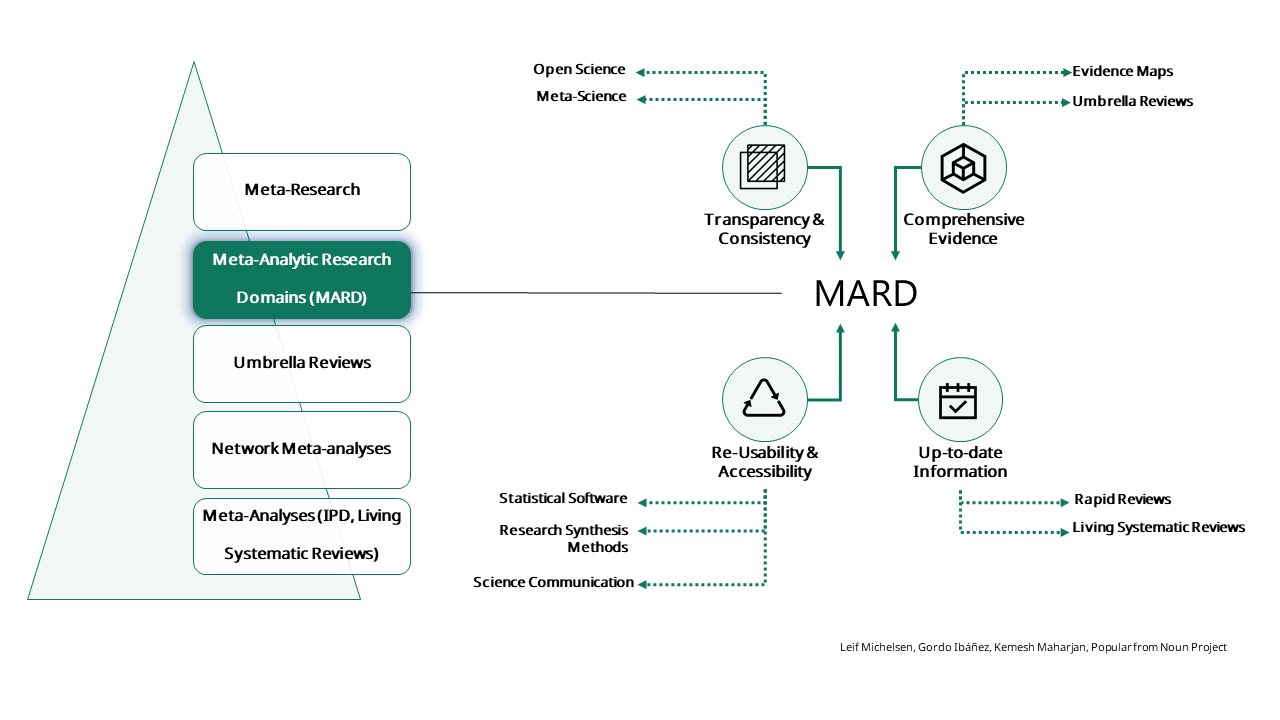
MetaCIH aims to serve as a centralized hub for meta-analytic research domains (MARDs; Cuijpers, Miguel, Papola, Harrer & Karyotaki, 2022).
MARDs are living systematic reviews of an entire research domain. In contrast to conventional systematic reviews and meta-analyses, MARDs do not focus on one specific population, intervention, comparison, or outcome (PICO), but on an entire research field that is too broad to be covered by one meta-analysis.
Many randomized controlled trials and meta-analyses are published each year. This makes it increasingly difficult to keep track of all existing evidence and draw actionable conclusions from it. MARDs provide a higher level of aggregation, in which all relevant evidence in a research field is provided in a consistent, transparent, and re-usable manner.
Like living systematic reviews, MARDs are updated regularly and therefore provide up-to-date evidence; but the scope of MARDs is much larger than what can be covered in one “living” meta-analysis or systematic review.
Like umbrella reviews, MARDs can cover a whole research field. However, MARDs do not “lag behind” like umbrella reviews often do. Furthermore, information included in MARDs is established using transparent and consistent standards, and can be easily reused or repurposed by the entire research community. Other advantages of MARDs include:
- Reduction of research waste. In the biomedical field, a great amount of redundant, misleading, and biased research is produced on a regular basis (MacLeod et al., 2014). This is also the case in psychotherapy research (Cristea & Naudet, 2019). By centralizing all available evidence, unnecessary work can be avoided. Transparent and consistent standards can lead to more trustworthy findings.
- Evidence Mapping. MARDs provide an overview of limitations and gaps in knowledge and make it possible to see emerging trends in the field
- Meta-Research (“Research on Research”). MARDs allow examining the methods and research practices of an entire field, and how they changed over time.
- Stakeholders outside the scientific community. MARDs can enable just-in-time evidence generation for specific research questions. This can be used by e.g. treatment guideline developers or clinicians, to get an overview of the current evidence.
- Open Science. MARDs provide data in a transparent, accessible, and interoperable way. This allows other members of the scientific community to re-use or repurpose the provided information.