Data Release
Once uploaded to a Github repository, evidence collections are officially released from the master/main branch.
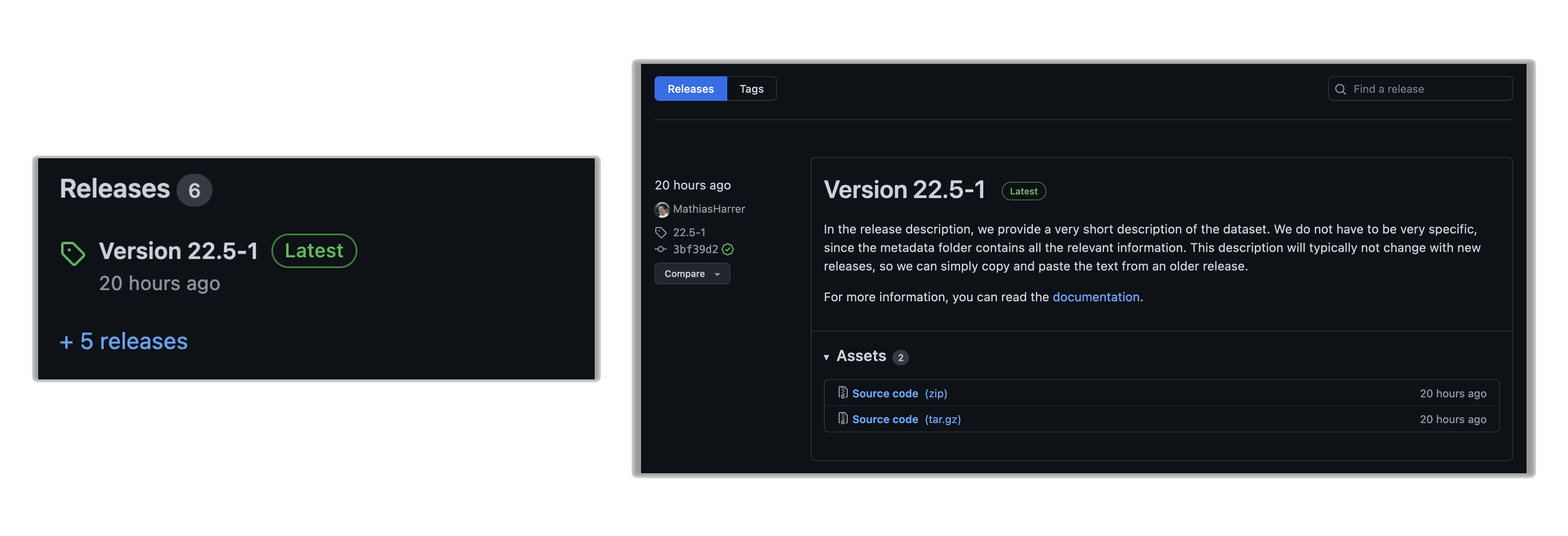
Versioning Convention
Annotated releases are published directly via Github. During this process, an ascending version number is created for the release. The version numbering convention used in MetaCIH is similar (but not identical) to the Semantic Versioning 2.0.0 standard:
MAJOR.MINOR.PATCH
- The
MAJORnumber is used for actual updates of evidence collections (i.e. new searches that lead to new studies being added to the evidence collection). Since most evidence collections are updated yearly, this number refers to the last two digits of the year in which the search was conducted (e.g.25if the search was conducted in 2025). If multiple searches were conducted in one year, theMINORnumber is used to differentiate the versions. - The
MINORnumber is used for all changes that affect the data (or metadata) of an evidence collection; especially changes that were made while the last study search stays the same. For example, this can be additions to the metadata of an evidence collection, or changes and corrections in the extracted meta-analytic data. This part of the version number always starts with0, and then goes up from there. - The
PATCHnumber is for minor bug fixes or corrections; for example typo corrections in release notes. Patch number changes mean that the evidence collection is still “backward-compatible”, meaning that values obtained by analyzing this evidence collection will still the identical. This part of the version number also always starts with0.
Therefore, if an evidence collection was updated (via a new search) in 2026, the first release version number would be 26.0.0. If many additions were made some time after than, the new version number changes to 26.1.0. If typos are fixed in this version, the new version number is 26.1.1, and so forth.
Zenodo Integration
Using a Github integration, all releases are automatically indexed in Zenodo. Zenodo automatically issues a Digital Object Identifier (DOI) for the latest release. For each evidence collection, there are two types of DOIs:
- Evidence Collection DOI. The Zenodo system refers to this as the “concept identifier”. It is an overall DOI for all versions of the evidence collection that will always resolve to the latest version.
- Version DOI. This is a version-specific DOI that allows referencing specific states of the evidence collection in the past.
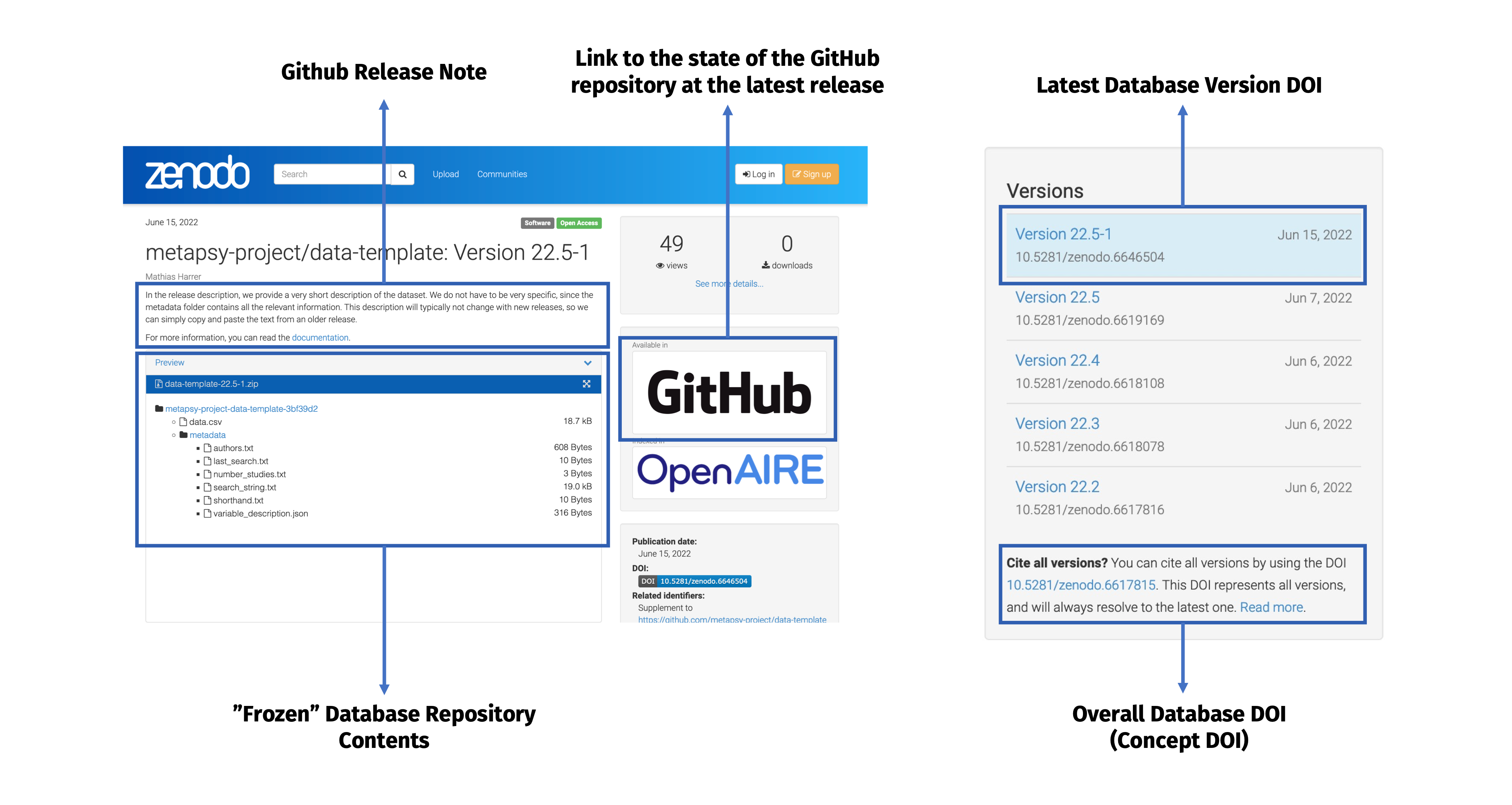
Once indexed in Zenodo, the released evidence collection and its metadata is automatically propagated to other components of the MetaCIH infrastructure, including the documentation entry and the MetaCIH API. This means that the new version of the evidence collection is publicly available to the entire research community. Preferred citations included in each documentation entry of an evidence collection are also automatically updated to reflect the year and version of the new release. This process is partially handled via the Zenodo REST API.